
Every successful project starts with something simple: an idea.
It could be a new business that needs an online presence, a brand looking for a refresh, or a website that no longer performs the way it should. Whatever the starting point may be, at Imbacactus we believe that the right process is what transforms an idea into a result with clarity, aesthetics, and purpose.
We don’t simply start by “building a website.”
We begin by understanding what the project truly needs, who it wants to reach, and what goal it is meant to serve.
1. The First Conversation: Listening Before Designing
The first step is always the conversation.
We want to understand your brand, what makes it unique, who your audience is, and what you want to achieve. At this stage, we are not only talking about colors, typography, or layouts. We are discussing the “why” behind the project.
We ask questions like:
- What is the goal of the website or brand?
- What should visitors feel when they interact with it?
- What are the key messages that need to be communicated?
- Are there examples you like — or want to avoid?
This helps us build a clear understanding before moving into the creative phase.
2. Understanding Needs and Building Strategy
Before any visual work begins, we build the strategic foundation of the project.
Depending on the needs, this may include:
- website structure,
- page architecture,
- content planning,
- tone of communication,
- and of course, user experience.
Good design is not only about aesthetics. It also needs to function properly. A website should help visitors instantly understand where they are, what you offer, and what the next step should be.
That’s why, in every project, we focus on clarity, flow, and the proper hierarchy of information.
3. The Concept: Turning Ideas into Creative Direction
Once we understand the goal, we move into the creative concept phase.
This is where the identity of the project begins to take shape. We define the visual direction, create moodboards, explore aesthetic approaches, and establish the overall feeling we want the final result to communicate.
For us, a concept is not simply “inspiration.”
It is the way we create consistency throughout the project — connecting design, brand messaging, and user experience into one cohesive direction.
At this stage, the project begins to develop its character.
4. Wireframes and Structure: Building the Foundation
Before the final design, we organize the structure.
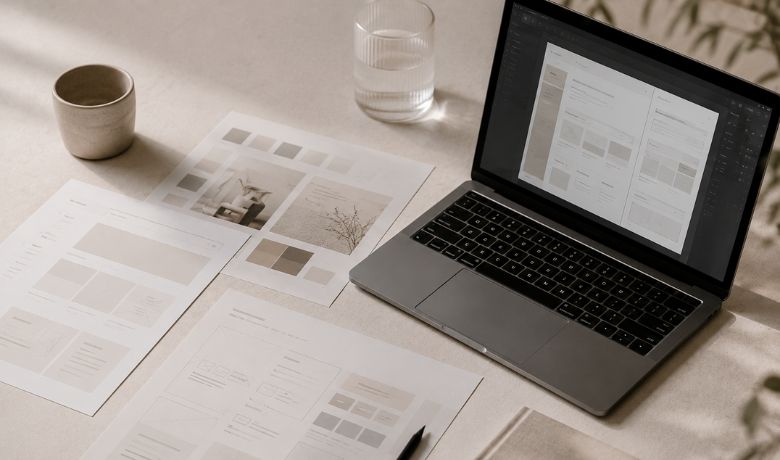
Wireframes help us define how each page will function, where content will be placed, and how users will navigate through the website. This stage creates logic and flow within the project.
Simply put: we build the structure first, and then we shape the visual layer around it.
This allows us to avoid unnecessary complexity, keep the design clean, and focus on the overall user experience.
5. Visual Design: Giving Form to the Idea
This is where the idea starts becoming visual.
We develop the visual design with the goal of expressing the brand’s identity with consistency and professionalism. We carefully select colors, typography, spacing, imagery, and visual elements that strengthen both the message and the experience.
For us, every detail matters. From the way a page “breathes” to the way the user’s eye moves across it. Balanced design does not simply attract attention — it creates trust.
6. Development: Turning Design into a Functional Experience
Once the design is finalized, we move into development.
This is where the project truly comes to life. We transform the visual direction into a functional website with proper performance, responsive behavior, and a technical foundation built to support both daily use and future growth.
We pay close attention to elements such as:
- loading speed,
- mobile experience,
- SEO structure,
- navigation usability,
- and clean technical implementation.
Our goal is to create a result that is not only visually strong, but also stable, flexible, and ready to support the growth of the brand.
7. Testing, Refinement, and Improvements
Before anything is delivered, we carefully review every important detail.
We test functionality, responsiveness across devices, page flow, and the overall user experience. If adjustments are needed, we refine the project until the final result fully aligns with the original vision.
For us, completing a project does not simply mean “it’s finished.”
It means the result is ready to perform effectively in the real world.
8. Delivery and What Comes Next
Delivering a project is not the end of the collaboration. In many cases, it is the beginning of the next phase.
A website or brand requires continuous care, evolution, and consistency. Depending on the project’s needs, we may continue with future improvements, new content, updates, or additional functionality.
What matters most is creating a foundation that can grow alongside the brand.
Why the Process Matters
At Imbacactus, we see every project as a collaboration focused on building something meaningful. When the process is clear, the final result becomes stronger. When strategy, design, and execution work together in harmony, the project becomes more than simply “beautiful” — it becomes effective.
And that is always what we aim to achieve.
From the very first conversation to the final delivery, the journey itself has value. Because that is where the quality of the final result is truly created.
